The Fire Game
Coxani rushed to the entrance of the portico to better see and Naran came up beside her. The mage—Saltanat, Tikran had said her name was—stood at the balcony, her hand moving through the air. For a moment, it felt as though all the air was sucked from the sky. Then the three Manzakars ignited from right to left. The crowd thundered. The newly initiated Aslans rode to a gallop and stood on their saddlebows, twirling their flaming poles. The fire swirled like ribbons over the Manzakars’ heads, dancing in synchrony with each flick of their wrists.
In the Slave-Soldier Series, the Fire Game is a rite of passage and a form of public entertainment. And I didn’t make it up…

The Mamluks
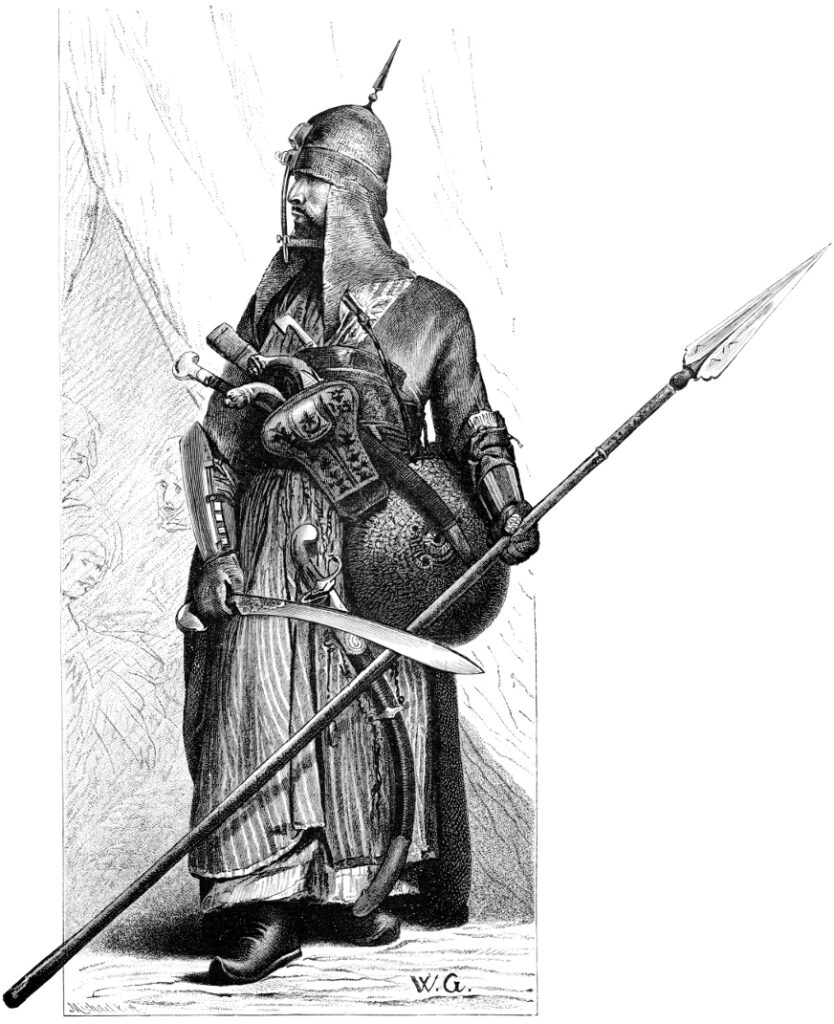
I’ve made no secret of the fact that my Manzakars are loosely based on the Mamluks, an elite caste of slave-soldiers from the medieval Islamic world.
For nearly three centuries, Egypt and Syria were ruled by the Mamluks. They were mostly Turkic children purchased off the steppe and out of the Caucasus, converted to Islam, and raised in barracks on a curriculum called furusiyya: horsemanship, archery, and the lance. When a boy finished his training he was freed (unlike my Manzakars) and joined the most formidable cavalry in the Mediterranean world. In 1250, the Mamluks took the throne and, ten years later, they did something nobody else had been able to do: Stop the Mongols.
I think it’s important to point out that they were not “slaves” in the western sense of the word. Being a Mamluk was never hereditary, even when the throne was—the ruling army renewed itself by purchase, not by birth. It was not based on race but religion, and the sultanate’s economy did not depend on their productivity. Mamluks were transformed into elite soldiers, freed upon completion of their training, fully armed, and became the rulers.
I’m not excusing it, by the way. That shit was brutal. I’m merely pointing out the differences between our concept of slavery and theirs in this particular case.
I suppose I could write a whole separate blog post about my family’s lineage, and maybe I will, but suffice to say that my interest in the Mamluks is personal: My mother was born in Aleppo, Syria, and her mother was an al-Ghuri—a lineage documented in Syria and a birth certificate marked royalty, for whatever that’s worth. We’re descendants of Qansuh al-Ghuri, the second-to-last Mamluk sultan, who reigned from 1501 to 1516.
He was likely bought as a boy, and he took his names the way a Mamluk (which literally means “owned”) did. His full name was Qansuh ibn ʿAbd Allāh al-Ashrafi al-Ghuri: son of the servant of God, the placeholder given to a purchased convert with no father on record, and al-Ashrafi, after al-Ashraf Qaytbay, the sultan who bought him. Al-Ghuri is probably from al-Ghūr, “a region in the lands of the Turks.”
The Mamluks bought children exactly because they were blank slates with no family, and therefore had no bonds to anyone.
It didn’t entirely work.

Light Up the Sky
Anyway, back to the Fire Game, which is based on a real attested practice that I staged in Manzakar:
Mamluk sources describe a khassaki—a royal Mamluk, one of the sultan’s own (Aslan, anyone?)—preparing for a fire display by attaching naphtha (petroleum incendiary) fireworks to a coat lined with raw talc, to a long pole, and to the talc-lined caparison of his horse. The talc was the armor. The naffatin, the infantrymen trained in the dangerous business of handling Greek fire, went into battle in the same talc-lined clothes.1
I don’t have permission to post Angus McBride’s amazing artwork of the “fire game,” (do a Google search), but I have something even better…
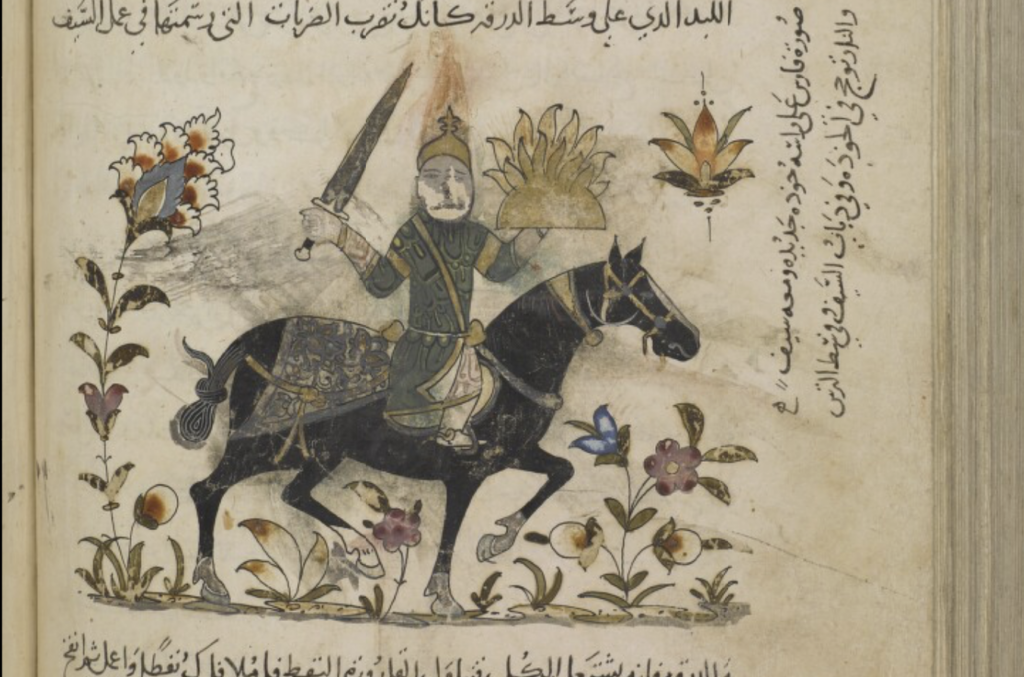
These “fire games” weren’t just stunts to make an audience gasp in awe; they were part of a serious, state-funded pyrotechnic culture. The Mamluks spent real money on fire. At a wedding in 1327, one of the sultan’s amirs commissioned a tower of gunpowder and naphtha that cost eighty thousand dirhams (which we can assume was a shit ton of money). At a festival called al-wāqid in 1418, oil and naphtha were put into eggshells and oil lamps and sent floating down the Nile.
They researched and wrote recipes that I would love to see with my own eyes: Al-Tarsusi records fifteen different mixtures. Al-Zardakash gives around thirty-five, plus forty-four types of missile. Ibn Mankili lists eighty-five recipes—colored smokes in red, black, blue and yellow; fire that walks on water; fire that burns hotter if you throw water or dirt on it and can only be put out with vinegar; mixtures timed for delayed ignition…2
These were people who thought about fire a lot.
And it was all highly political, too. Mamluk military skill was performed in public and at state occasions. The Mamluks had a whole discipline for it—the qabaq, to which I will devote an entire post in the near future.
So the Fire Game isn’t the fantasy part. The fantasy part is the mage, Saltanat, standing on the balcony and waving her hand in the air.
Everything on fire below her is history.
Which leads us to…
The Mamluks were the most fire-literate military culture in the Mediterranean and they almost never used fire to fight.
The Mamluks were strangely reluctant to take fire into open battle. The story that Greek fire beat the Mongols at Ayn Jalut is a later invention and probably didn’t happen. In reality, the Sultanate almost never used incendiaries in the field. The one serious attempt came in 1299, when a Mamluk attack was led by five hundred naphtha throwers. The Mongols looked at five hundred men carrying fire, kept out of range, and waited.3
Aaaaand…the naphtha burned out.
Eighty-five recipes, a bronze syphon that threw a jet “as long as a lance,” distillation techniques ahead of anything in Europe, kites rigged to drop incendiaries… but on the battlefield?
So instead, they used it to scare the shit out of their enemies.
Hasan al-Rammah, writing around 1280, describes samarikh, explosive firecrackers carried by infantry and cavalry for the specific purpose of scaring the enemy’s horses. In a war fought entirely from the saddle, a horse’s terror of fire is the one thing no amount of training fully drills out.
Besides, unlike an arrow, you don’t have to aim a firecracker.
- David Nicolle, The Mamluks 1250–1517 (Osprey Men-at-Arms 259), plates C1 and D1. Nicolle’s sources for the Fire Game are furusiyya training manuals, fifteenth-century copies of mid-fourteenth-century originals, in the Asiatic Institute Library, St Petersburg, and the Keir Collection, London. ↩︎
- Tarek Galal Abdelhamid, “The Development of Pyrotechnics and Firearms in the Mamluk Period” (Journal of the Faculty of Archaeology, Cairo University, vol. 19, 2016) ↩︎
- Nicolle, p. 14. ↩︎
Comments (0)