 By ha11ok
The Mounted Archery Tournament
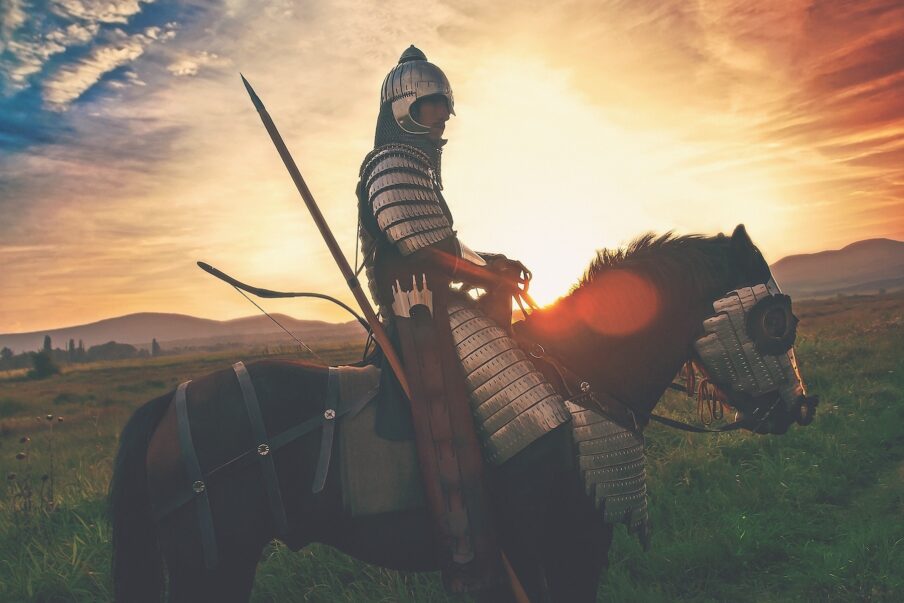
With a quiver full of arrows at his hip, Tikran mounted his horse and followed the other competitors out to the arena grounds, which were brightly lit with torches… the goal was to hit four gourds that hung from the tops of increasingly taller poles. At the top of each player’s last pole hung a golden birdcage. The aim was not to strike the bird within it, but to hit the latch that would open the door and set the bird free.
Did I invent this scenario? NOPE. Like the Fire Game, this came straight out of history, and it was called qabaq.
Before I start to talk about the mounted archery tournament itself, I’d like to address a bit of etymology/metonymy: The word qabaq literally means “gourd” in Turkish (Persian qabāq, Arabic qarʿa). So, like, a squash or pumpkin.
Most of the sources I’ve read don’t have qabaqs where the participants have to shoot a literal gourd at the top of the pole. One source says it was a wooden ring that you shot through to hit the actual target; others suggest it was a hollow sphere or vessel, sometimes with something inside it. Sources say that the targets were pumpkins or squash or melons in the beginning and possibly during practice, but became more sophisticated over time and for ceremony, which makes sense. Also over time, the word went from meaning an actual calabash to “thing at the top of a pole that we shoot at with an arrow.”
If you’ve read Manzakar, you know I use actual fruit.
Anyway, back to the archery tournament…
Agnès Carayon, writing on the hippodromes of Mamluk Cairo, described the birdcage as one of the most elaborate forms of the qabaq. She says (and this is a translation from French, so be gentle): “…the archer has to aim at a piece that triggers the opening of the cage and then the bird’s release, which requires a shot of great precision.”1
Then later she adds (again, this is translated from French):
The target was no longer a common gourd but a cage of precious metal, and a sophisticated mechanism opened if the shot succeeded… it was no longer a matter of killing the bird, but of freeing it.2
Carayon didn’t pull this out of her ass. Ibn Taghrībirdī, the son of a Mamluk commander-in-chief, explained that the target served as the horse archer’s “pigeon-box,” and at festivals, Mamluk horse-archers competed “by freeing the birds from their mast-top prisons.” If the target was made of gold or silver, it was given to the winner as a prize, along with a fancy robe.3 Although, to be fair, it wasn’t just a fancy robe—the khilʿa was an instrument of rank, and being robed was like being promoted.
And look, I’m here for it. I’m so here for it, in fact, that my main character’s Manzakar name is the “Caged Kingfisher.” It’s brilliant fiction, let alone actual human history.

How the Shot was Made
Now for the fun stuff.
Most of my mechanics were drawn directly from Ṭaybughā al-Ashrafī al-Baklamishī al-Yūnānī (thank the gods for copy/paste) who was a Mamluk and archery grandmaster. He wrote what is still considered the oldest comprehensive archery manual around 1368, and translators J.D. Latham and W.F. Paterson insist that the manual “is definitely not the work of a theorist, but of a practising expert.”4
My rule—“the players weren’t allowed to prepare their shot until their horses were in full gallop”—is Ṭaybughā’s manual requirement turned into a tournament regulation. Ibn Taghrībirdī has the riders shooting (translated from French) “while their horses are running” and Ṭaybughā has the shot taken “in mid-career.”
Tikran drops the reins and, in the training scene with Coxani, tells her to control her horse with the pressure of her legs alone. This is Ṭaybughā exactly, who trains the horse specifically to keep galloping “after the reins have been dropped from the hand.” Cantering, galloping, then shooting is also Ṭaybughā, as is Tikran’s lecture to Coxani about stride terrain, and wind—loosing her arrow when her horse is “in flight,” with all four legs off the ground.
And now for my favorite part: the jarmakī.
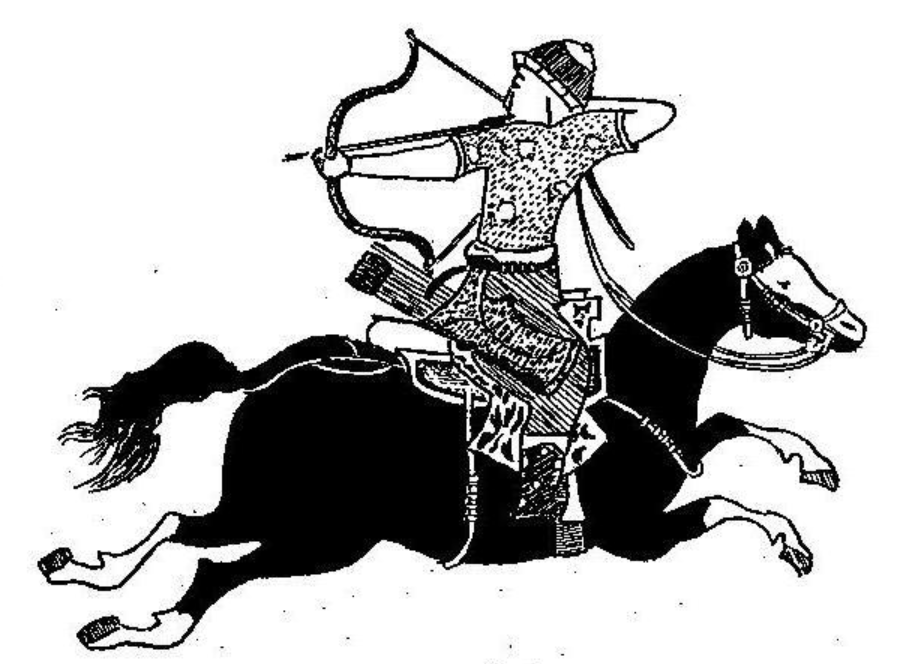
Tikran does this to make an impression on Coxani during the training scene, and it works: It’s a backward shot, and she rolls her eyes and thinks, Show off.
Ṭaybughā described the multitude of ways an archer could manage it, and honestly, I had a hard time visualizing some of it. In one variation, the archer draws, raises his bow arm, then ducks his head under his own elbow until his drawing hand sits at the back of his neck…and from there shoots behind him, close along the horse’s flank, on whichever side he prefers…

Good grief, my neck hurts from trying to imagine it, let alone attempting it.
Needless to say, an archer had to be very, very good to pull this stuff off.
Latham and Paterson note that the jarmakī prevents aiming along the arrow, since the draw sits behind the head rather than at the chin or the side of the face. So the archer has to trust his instincts, which is only as good as his experience. If he can manage it, however, he strikes targets further around without turning his horse. The authors add that the shot is especially useful at close range, when the rider is nearly on top of his target, and that an archer on a wall could use it against someone at its foot.5
The qabaq, as you can imagine, was a spectacle. The Mamluk sultan Baybars started the craze and made it a daily thing in 1267 by shooting at targets and goading everyone else into shooting from noon until the last evening prayer. The pastime became so popular that (translation of Arabic incoming) “no amir and no mamluk had any other occupation.”6 The crowds that came to watch grew large enough that street vendors set up shop to feed them, and at the Ramadan festival of 1273 the sultan was forced to admit only 20% of the people who wanted to attend so that no one got crushed in the masses. My ancestor al-Ghuri‘s qabaq spectacles were staged at night under a thousand candles, and before the court and foreign ambassadors. (What a show off.)
Al-Maqrīzī, a fifteenth-century topographer of Cairo, ends the festival with a list of things given away: money, food, alms, and… manumissions. It’s what one expected from a generous ruler, but it reads differently at these particular games, where the competitors were freed slaves.
- Agnès Carayon, La Furūsiyya des Mamlûks : Une élite sociale à cheval (1250–1517) (thèse de doctorat, Université d’Aix-Marseille, 2012), p. 366, https://theses.fr/2012AIXM3027. ↩︎
- Carayon, p. 370. ↩︎
- J. D. Latham and W. F. Paterson, trans., Saracen Archery: An English Version and Exposition of a Mameluke Work on Archery (ca. A.D. 1368) (London: The Holland Press, 1970), p.77. ↩︎
- Latham & Paterson, p. xxxvi ↩︎
- Latham & Paterson, pp. 82-83. ↩︎
- Carayon, pp. 369–76. ↩︎
Comments (0)