
The Search for Howel Davis: Part One
Thus like a game Cock, giving a dying Blow, that he might not fall unrevenged.
There is exactly one account of how Howel Davis1 died that most people have ever read, and it ends like this—with the word “cock” in it.

Even so, it’s a great line and a cinematic, heroic end to a pirate who managed to smooth-talk his way into forts and come out richer.
But is it really how Howel Davis died? How much does the historical record actually tell us about his life, career, and death?
Johnson: The author who never names a witness
Everything Howel Davis is remembered for, his entire pirate career, happened within a year, and most of it comes from a single source: A General History of the Robberies and Murders of the most notorious Pyrates, published in London in May 1724 under the name Captain Charles Johnson. Trust me, I’ve read everything I could find on Howel Davis, the Golden Age pirate and the hero of The Noble Pirates, and almost every account of him leads back to Johnson’s book.
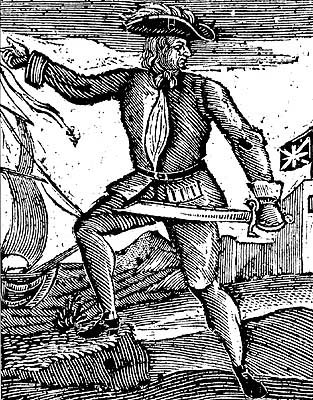
Davis was Welsh, probably from Milford Haven in Pembrokeshire. According to Johnson, he was chief mate of a Bristol slaving snow called the Cadogan when she was taken off Sierra Leone by the pirate Edward England, whose crew murdered her captain. The story is that Davis refused to sign the pirates’ articles, saying he’d rather be shot to death than become a pirate. England was so impressed with this slaver’s first mate he gave him the ship and its cargo.
His crew was unhappy with this turn of events and refused to follow him. They sailed to Barbados instead, where Davis spent three months in prison before being released. He found his way to New Providence in the summer of 1718, and managed to get employment aboard one of Woodes Rogers’ trading sloops, the Buck. Off Hispaniola, he and some others took the ship overnight.
After this, a Counsel of War was called over a large Bowl of Punch, at which it was proposed to chuse a Commander; the Election was soon over, for it fell upon Davis by a great Majority of legal Pollers…
For several months, Howel Davis captured the popular imagination by being cunning, charming, brave, and a very good actor.
As the story goes, Davis was ambushed on Príncipe in the summer of 1719, shot as he walked away from the governor’s house, and as he went down he pulled his pistols and fired at the men chasing him.
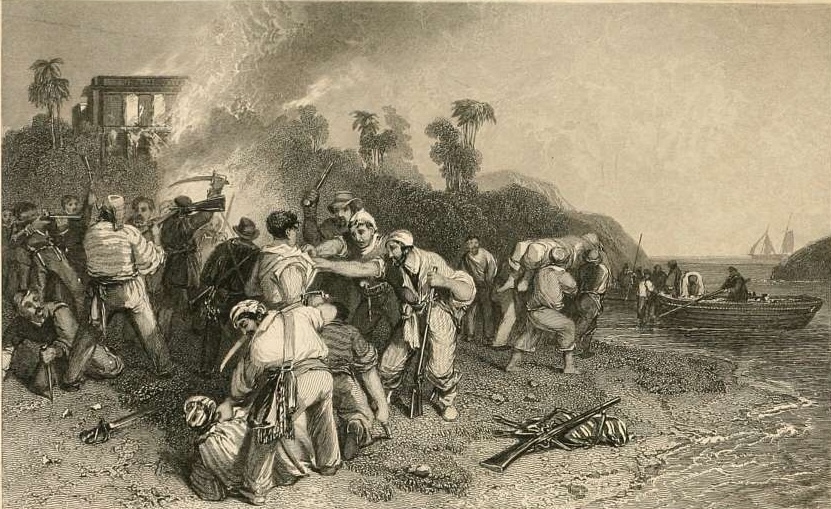
I chose Howel as the hero of TNP in large part because of Johnson’s account:
…the Company resolv’d to revenge Captain Davis’s Death, he being more than ordinarily respected by the Crew for his Affability and good Nature, as well as his Conduct and Bravery upon all Occasions…
Here’s the problem: There was no Captain Charles Johnson. It’s a pseudonym, and for most of the 20th century, people believed it was Daniel Defoe, the author of Robinson Crusoe. More recently, it’s been suggested that Johnson was Jacobite newspaperman Nathaniel Mist. A novelist and a newspaperman, respectively.
And this matters because the entire book reads like fiction (in case the “game Cock” quote didn’t make you wonder). We’re told what people in the accounts are thinking and feeling, and while Johnson repeatedly claims he has sources, he never names them. Still, a lot in the book checks out when compared to the historical record, which means he did use sources, and likely very good ones. So it isn’t complete fiction.
Either way, it’s hard to know how reliable Johnson’s book actually is.
So, what do the more “reliable” sources say about Howel Davis?
The hunt begins
Honestly, I didn’t think there was much to find other than what I’d found already. And let’s be clear, I was looking for primary sources. I’d found plenty of blog posts that quote books that quote primary sources (most of which was—you guessed it—Captain Johnson), but that’s not what I was looking for. I’m a historian at heart, after all…
(I’m leaving William Snelgrave out for now, and I’ll explain why later. Patience, my loves.)
And the record seemed eerily silent on Howel Davis, even when I was personally going to libraries and requesting to view microfilms. Yes, I did that. I walked into Fondren Library at Rice University and used one of these things for the first time since 1998.

And look, folks, I’m not going to bitch and moan about how the National Archives in Kew, London needs to catch up with the times and digitize their records on Golden Age pirates, okay? I’m sure they’re doing a lot of more important things.
Unfortunately, this is what my efforts got me: He isn’t in the Calendar of State Papers, Colonial: America and West Indies. Not in Volume 29, 30, 31, or 32, 1716 through 1721. Not as Howel, Howell, Hywel, or Hywl; not as Davis or Davies. The Calendar is the British government’s running record of its colonies. It recorded every petition or sworn deposition from every governor in every faraway land in its clutches, then summarized and published it by His Majesty’s Stationery Office.
I couldn’t find anything on Howel Davis.
Woodes Rogers, the governor of the Bahamas from 1718 to 1721, never mentioned him. He wrote about the Spanish and the money. Good grief, he wrote ad nauseam about the eleven thousand pounds he spent on the fort and wanted Parliament to pay back. He wrote about his own soldiers conspiring to seize him and give Nassau to the pirates. He reported hanging a man for burglary.
He even wrote to the Board of Trade about sending the Buck out to open a trade with Hispaniola. And never, anywhere, the name of the pirate who stole her.
My eyes were crossed from staring at bad PDF scans of old-timey script (not by candlelight, thank goodness) and I wondered how the whole lot of them didn’t go completely blind. I looked again into the stupidly old records I had already downloaded, namely Calendar of State Papers, Colonial: America and West Indies, Vol. 30 (August 1717 – December 1718). I did yet *another* search for Davis, except this time, I’d had a bit too much wine and left off the “i” and “s” in my search…
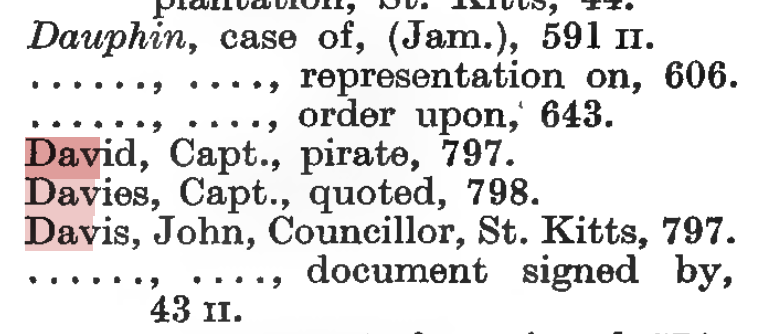
797…797…
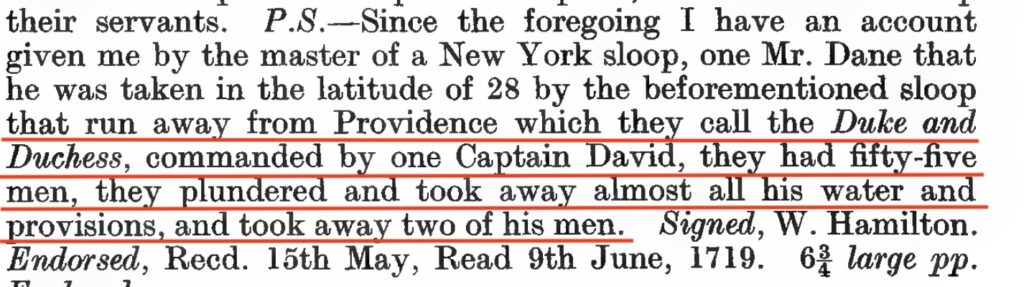
A sloop, taken by pirates from Nassau in autumn 1718, but the ship’s name was all wrong. There was no way the record had effed up the pirate’s name AND the ship’s name…was there?
It was becoming increasingly clear that the only way to find him was to book myself a ticket to London. Except the sources are also in Edinburgh, Scotland — and some of them are at Inveraray Castle, which is privately owned by a duke. Which complicates the issue a WEE bit.
At the end of my rope, I did one last Google search, this time using AI mode: “Howell Davis primary sources.”
The AI summary at the top showed something I hadn’t seen before:

This entire exercise strikes me as funny, considering I was knee-deep in British library archives and badly scanned primary sources. And then the AI summary just pulled it out of nowhere.
The books, Pirates in Their Own Words Volumes I and II, a collection of primary sources—letters, testimonies, witness accounts, newspaper articles—compiled by E.T. Fox, are $25 each and I wasn’t ready to make that kind of commitment just yet. After all, if the author could find him, so could I. Right? Right?
It was about nine in the evening on a Wednesday when I decided a couple books were cheaper than an in-person library/castle tour of Great Britain (as amazing as that would have been), spent the $50, and began reading immediately.
And to my (exhausted) delight, Howel Davis is all over the record.

- “Howel” and “Howell” are anglicized forms of the Welsh name Hywel. The root is Old Welsh “Higuel,” meaning eminent or prominent. “Davis” and “Davies” are variant spellings of the same patronymic, meaning “son of David.” I chose to use “Howel Davis” because it’s what Captain Johnson used, and his account is what introduced me to the pirate to begin with. ↩︎
Larry November 16, 2026 at 3:56 am
Fascinating!
admin November 20, 2026 at 8:07 pm
Right?? I love that stuff.