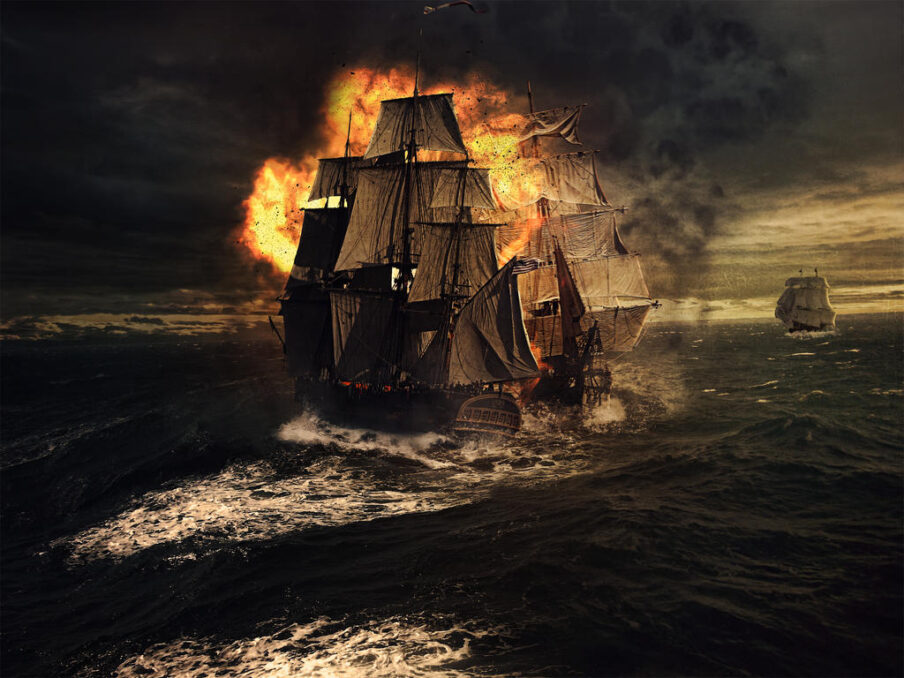
The Search for Howel Davis: Part Four
The fire (part two).
Everyone went up, and I scurried after them.
The deck was chaos. There were fifty prisoners on board, plus a mix of freshly pressed and hardened pirates, and all of them were either running, standing perfectly still, falling over drunk, laughing, or sobbing. Walter was among the laughing ones, but his eyes were fixed on Howel. All along the side, men were dropping into the boats in the dark, one after the other, and the tide was taking them silently away from the ship.
The three captains were at the rail, looking down into the waist and watching it happen. Howel wiped at his mouth with his sleeve and muttered, “Well, shit.”
“Howel, the fire…” My voice was barely a whisper.
“We cannot stop them.” Howel stared at the boats.
I swallowed. Was he really more concerned about the men leaving than the ship exploding? Why?
Snelgrave came and stood at the rail beside me. His voice shook ever so slightly. “Captain Davis… They’re the sober ones. If they go, there won’t be anyone to fight the fire.”
No one said anything for several moments. Somewhere below us, something collapsed and made me jump.
“Fire the quarterdeck guns,” Snelgrave said. “At the boats.”
Howel turned his head, and Walter was already standing at his shoulder. Neither of them needed to speak—something passed between them that made Walter turn and roar the order down the deck.
Howel’s men—most of them drunk—scrambled to the quarter deck guns upon hearing their quartermaster’s command.
“Miss them, d’ye hear?” Howel called after them. “We want them turning back, not ending up fish food.”
I covered my ears a half second too late. The quarterdeck guns went off beside us one after another and I felt each one through the deck and in my teeth. Out in the dark there was shouting and oars splashing frantically.
Cocklyn and Levasseur grinned, and I understood why Howel hadn’t ordered it done to begin with: He didn’t have the right to do it.1
And there was still a fire. And thirteen tons of gunpowder. And Cocklyn and Levasseur were watching cannons fire over the heads of desperate men and cackling about it, and Howel was watching the boats with a stony face.
I spun around to find Snelgrave gone2 and the men on the deck split into two distinct groups: the hardened pirates who had been with Howel from the start were back amidships with the casks, laughing and singing and toasting, “For a brave blast to go to Hell with!”
The other group was the new pirates, men who’d signed just weeks ago and those who’d been pressed against their wills. They were crying against the larboard rail in the dark, or scurrying out along the spritsail yard and dangling over the black water, trying to get as far away from the middle of the ship without jumping off.
I looked around frantically and saw Sam standing there, watching the main hatch. As I tried to determine his expression—which was damn near impossible—the after hatch opened right beside my feet and John Taylor, the ship’s master3, burst from it.
I didn’t know Taylor well at all; in fact, I had avoided him because Howel had told me to. The ship’s master was dark-haired, young-ish, and always angry, but Howel claimed he was excellent at his job.
Taylor said something I couldn’t hear, and Howel nodded once. Taylor then led fifteen men down into the smoke, and I held my breath as I watched.
Howel threw off his coat, casting it on the deck, took two steps and had his hands on the lip of the hatch. Then Cocklyn’s hand came down on his shoulder.
“Here now, Davies,” he said in that fat, wheedling voice. “Stay and drink. Let the men do what they’re paid for.”
Howel lifted his head to snap back when his eyes landed on me. He froze and went silent.
“’Tis not for a captain to go crawling about in his own hold,” Cocklyn insisted. “Where’s the dignity in it, I ask ye? Let ‘em earn their shares.”
Howel said nothing as he straightened and approached me. He didn’t move quickly or in any way that would have made someone who wasn’t watching his face wonder. He crossed the quarterdeck until he stood in front of me and said quietly, “Get in a boat.”
I managed, “There aren’t any boats.”
“There’s one at the stern. Sam’ll take you.” He was looking at me directly, in front of Cocklyn and Levasseur and all the men on the deck for the first time in weeks. “Go now.”
“The river is full of sharks.”
“Aye,” he answered, his voice rough. “And the ship’s full of powder. Go. Now.”
Sam was at his elbow, his eyes darting between us. “Nwanyi.”
“No.” I didn’t move.
Howel’s nostrils flared even as his voice stayed low. “Sabrina—”
“No,” I said again. The love of my life was standing on thirteen tons of gunpowder and I refused to be a mile off in a boat watching the sky go orange. “I’m not going anywhere.”
I could tell he was furious. His jaw flexed and his eyes blazed. “Then stand where I can see you.”
“Davies, look what me men found.” Behind him, Cocklyn held up a bottle of Madeira by its base and grinned. “Let’s toast to a noble blast, one to go straight to hell with!”
Howel turned, swept his coat from the deck and back on in a single move, then drew his cutlass.
Oh my God.
I’d like to say I knew what he was about to do, but I’d be lying. I’d watched him talk angry men out of murder, but I’d also just watched him agree to fire guns at his own men. I had no idea which version of him I was about to see next.
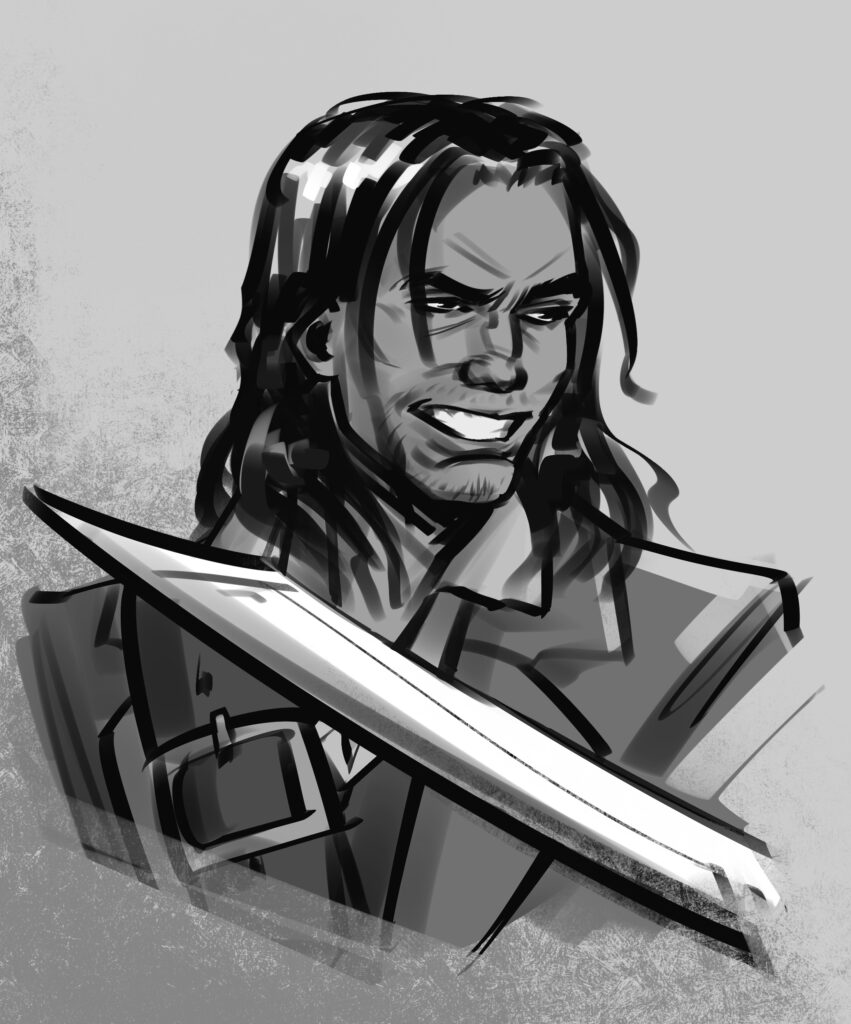
Cocklyn didn’t move. He stood there holding the bottle out, his grin fading from his face slowly, by degrees.
Howel set the edge of the cutlass against the neck of the bottle, just under the lip, and held it there a second. Then, in full view of every man aboard, the captain of a ship that was on fire swiped his blade at a bottle of Madeira, cutting off its top with one clean slice.
Not a drop of wine spilled. The old hands roared.4
“To a noble blast,” Howel said. He took the bottle from Cocklyn and drank, pouring the wine directly into his mouth from the broken end of it, and handed it back.
Cocklyn laughed like he’d just won something, drank from the bottle as well, then turned and offered it to Levasseur.
Without looking at me, Howel hooked a foot around the carriage of a quarterdeck gun, turned it enough to sit on, and dropped down on it. He swung his boots up onto the ship’s side, tipped his hat forward over his eyes, and folded his arms.
“Wake me when she goes up,” he said.
Cocklyn laughed again, gleefully, as if it were the funniest thing he’d ever heard in his life.
I had never wanted to hit Howel so badly. I was itching to walk up to where he sat, with his nice coat and his boots up while sixteen men were under our feet in the smoke, and punch him. Was he really going to take a nap while his ship burned just because I wouldn’t get on a boat?
The pirates amidships had started singing again. A strange air of resignation settled over the panic as the minutes dragged into an hour, even as men took the gratings off the hatches and lowered them over the side on a rope. Many of them couldn’t swim, but they were going to take their chances with the sharks rather than stay on the ticking time bomb that was Howel’s ship.
I finally sat on the deck, back against the bulwark, low and out of the way, seething.
That’s when I noticed that he wasn’t sleeping at all. Men would emerge from the darkness, sweat streaming from their faces, and rush to him. The brim of his hat would come up an inch and there’d be a muttered exchange. Then the men would rush off again and the brim would go back down.
I started to listen.
“How far aft?”
“Past the main. Not to the bulkhead.”
“Ye’re certain.”
“Aye.”
“Go and be certain again.”
Ten minutes later:
“The Windham’s put a boat out, Captain.”
And Howel, without moving: “They’ll be an hour pulling against the tide and get here in time to watch.”
Cocklyn and Levasseur were visibly drunk at this point, leaning heavily against the rail with the nearly empty bottle. Every time Cocklyn would jut his chin out and begin to complain, Howel said something from under his hat that would make him laugh and forget what he was saying. Cocklyn would then continue to drink.
This went on for what felt like an eternity—Howel responding to the men who approached him, to the drunk pirate captains at the rail, and occasionally looking out from beneath the brim of his hat.
At one point, I thought he might get up. A sailor came up to him and said something quickly, and Howel tipped the hat back, took his boots off the gun. He looked forward along the deck to the bow at a man who stood there with an axe, and the man looked back at him in anticipation.
“Not yet,” Howel said. “Go down and tell him not yet.” And he put his boots back up.
It was nearly ten o’clock when they finally came up out of the hatch and declared the fire was out.
John Taylor staggered up and put his hands on his knees; someone brought a lantern close and we saw how badly he’d been burned, along his forearms and the side of his neck.
“Where are the surgeons?” Howel was finally on his feet. He didn’t look at me, even though I expected him to. “Let’s get those burns dressed.”
Taylor looked hard at Howel, and I knew, without a doubt, what he was thinking.
His captain had been sitting on the quarterdeck, his boots propped up, drinking the entire time he and fifteen others had been fighting the fire.
And the worst part was that he wasn’t wrong—every single thing he’d seen was true.5
- Snelgrave writes, “they [the pirate captains] all in confusion said, ‘We know not what to do in the matter.’” They’re standing on Davis’s ship, which means Davis most likely spoke, and he was talking about the men abandoning the ship, not about the fire. As Snelgrave pointed out, the men fleeing in the boats were the sober ones and if they left there would be no one left to fight the fire. And here’s what likely caused Davis’s consternation: He was a pirate captain, and he couldn’t compel them to come back. As per Johnson, the only two instances where a pirate captain could force his men to act was either during chase or battle. Moreover, only the quartermaster had the right to punish them. So by giving the order to fire on his own men, Davis would have been violating custom if nothing else. ↩︎
- By his own account, Snelgrave went down into the steerage, where the gunner’s mate, Goulding, had called for blankets and water—“which if not brought immediately, (he said) the Bulk-head of the Powder-room would be fired, and the Ship soon blown up.” Snelgrave and some others grabbed several blankets and rugs and flung them to Goulding, and that he then went up on deck, found men who were sober, and set them drawing buckets over the side. He records that Goulding told the crew what he had done, and that they saw him differently afterwards. ↩︎
- Taylor was the King James’s sailing master, meaning the guy who navigated and worked the ship. Unlike the captain and the quartermaster, he was not elected. He held his place by skill, and pirate companies routinely forced masters, surgeons, and carpenters out of captured ships because those skills were scarce. He was the best paid of the working officers and the least powerful of the principal ones. ↩︎
- Snelgrave described Howel’s men doing this exact thing, saying “they would not give themselves the trouble of drawing the Cork out, but nick’d the Bottles, as they called it, that is, struck their necks off with a Cutlace; by which means one in three was generally broke”. ↩︎
- Soon after this incident, Taylor—the ship’s master who’d gone into the burning hold and put out the fire—tried to take Howel’s command. Snelgrave says Cocklyn put him up to it, but never connects it to the fire. I made that up. What the record actually shows is this: Taylor was badly burned saving the ship, no captain appears anywhere in Snelgrave’s account in that hour and a half, and within the week he wanted Davis deposed. Empty spaces in the record are ripe for fiction… ↩︎
Comments (0)