The Dangers of Stringing a Bow
In celebration of the release of Manzakar, my husband gave me a laminated recurve/reflex bow, similar to what my characters would have used. I mean, I’d been writing about the medieval archery of west and central Asia for months and had done a ton of research, so it was a fitting gift. It arrived unstrung, obviously, and as I attempted to string it for the first time, I realized that stringing a bow, in itself, is, um, hard.
I couldn’t do it. I had to order a stringer off Amazon because I was going to hurt myself.
Watch me string my bow on Instagram.
And mine just has a twenty pound draw weight, for goodness sake. How did medieval archers string bows that had an average draw weight of 111 pounds?
You have to bend it backwards.
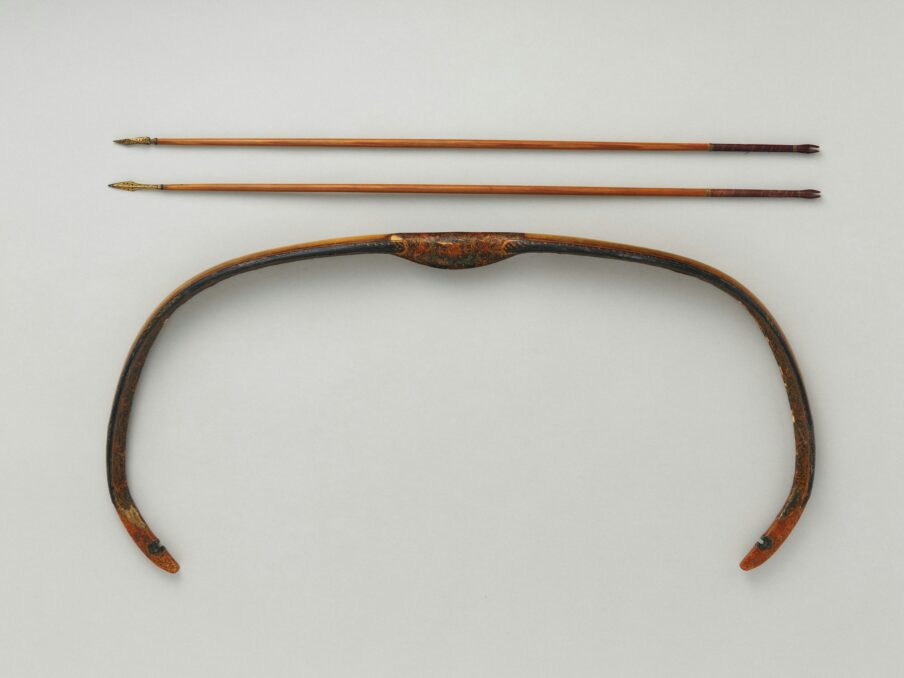
Unstrung, these bows are C-shaped and look nothing like a bow. Stringing it means turning it inside out—the whole thing gets bent backwards and its shape changes completely.
Sir Ralph Payne-Gallwey, who owned a collection of Turkish composite bows in 1907 with draw weights of a hundred and eighteen pounds, wrote, “In these days no person I have ever heard of can string a strong Turkish bow—diminutive as this weapon is—without much personal assistance, or else by mechanical means.” He added that “formerly the Turkish archer unaided could do so with ease.”1
So how did they do it?
According to Muḥammad ibn al-Ḥasan al-Harawī2, there were a hundred and twenty ways to do it. Yes, just to put a string on a bow. And when you read the names of the methods, you understand why there were so many. An anonymous Arabic manual from around 1500 called “Arab Archery” describes many of them:
“The bracing of the wounded” is done one-handed with the foot between the string and the bow, the string running between the legs… This isn’t describing a technique. It’s describing a major effing predicament, where you’re using your foot because something’s happened to your other hand. Also, the author goes on the describe shooting the bow one-handed, which involves both feet and… yeah.
Another one is called “the bracing of the frightened and fleeing archer,” and it tells you how to string a bow while running for your life. The archer is supposed to smack the lower limb of the bow against the ground to string it, and the whole method has a special “don’t try this at home, kids” warning attached to it, except the warning is directed at experienced medieval archers.
Based on those two methods alone, you can start to see the kind of day the authors expected an average medieval archer to have.
Ṭaybughā3 (same dude whose name I had to copy and paste in the archery tournament post) has one method for “bracing on horseback while charging,” where you set the lower limb against the base of the horse’s neck and use the horse as your brace, which I’m pretty sure the horse didn’t enjoy. He has another one where, if you have to, you hold the free loop of string in your teeth. Yes, to string a bow.

They had stringers too.
When they weren’t trying to string a bow while running for their lives, the medieval west/central Asian archer had tools to help them with the stringing, similar to my modern stringer. Ṭaybughā describes a broad strap about four feet by three inches with a loop at each end, hooked to the limbs and run behind your back—then you draw with your waist and push with your feet, exactly as you would span a stirrup crossbow. Which means they were using some bows with SERIOUS draw weight.
And there were indemnity laws.
Ya. I’m serious. If you broke a bow stringing or unstringing it in an “unsanctioned” way, you had to pay damages to the owner. Bows took a long time to make. A Turkish composite took up to three years to craft, and a Mongol-era one needed nine or ten months of active work, with a three-week wait while each sinew layer cured. Bows weren’t just weapons—they were works of art. And the implication here is that a lot of archers were stringing bows that didn’t belong to them.
So what’s a poor archer to do? Well, first and foremost, make sure you string the thing correctly (unless it’s a life or death situation, in which case stringing is the least of your problems. At least if you die, you don’t have to worry about paying the fine.)

But yeah, besides that, there were ways to ensure your bow wouldn’t break if you were too rough with it.4 You inspect it first, and the two limb tips should lie in the same plane. If they cross, don’t string it yet. Warm it first. In Gohar Rises, I have Tikran do this very thing:
Tikran had been standing on the tower’s northeast corner for several minutes with Coxani’s bow inside his cloak and against his tunic, using his body’s heat to warm it.
Ṭaybughā wrote, “If in winter when the weather is cold, his best policy is to put the bow inside his clothes and warm it with his body. When going to bed at night, he should also keep the bow inside his clothes to protect it against the damp.”
And that would make sense, since it was Coxani’s bow. He was just borrowing it, and if he broke it, he’d owe her money.
- Sir Ralph Payne-Gallwey, The Projectile-Throwing Engines of the Ancients, with a Treatise on Turkish and Other Oriental Bows (1907). Public domain; Project Gutenberg 74719. ↩︎
- Arab Archery, trans. Nabih Amin Faris and Robert Potter Elmer (Princeton, 1945), from an anonymous Arabic manuscript of about 1500 — ch. 10 (testing before bracing), ch. 11 (the twelve methods and the liability rule), and p. 29, cited by Latham for al-Harawī. ↩︎
- Ṭaybughā al-Ashrafī al-Baklamishī al-Yūnānī, Ghunyat al-ṭullāb fī maʿrifat ramy al-nushshāb, trans. J. D. Latham and W. F. Paterson as Saracen Archery (London: The Holland Press, 1970). ↩︎
- Arab Archery offers another few ways to test a bow, and one is by striking the sinew back lightly with a small piece of iron or a stone. “If they resound with vibration, they are whole and fit.” A sound bow goes DINGGGG. ↩︎
Comments (0)