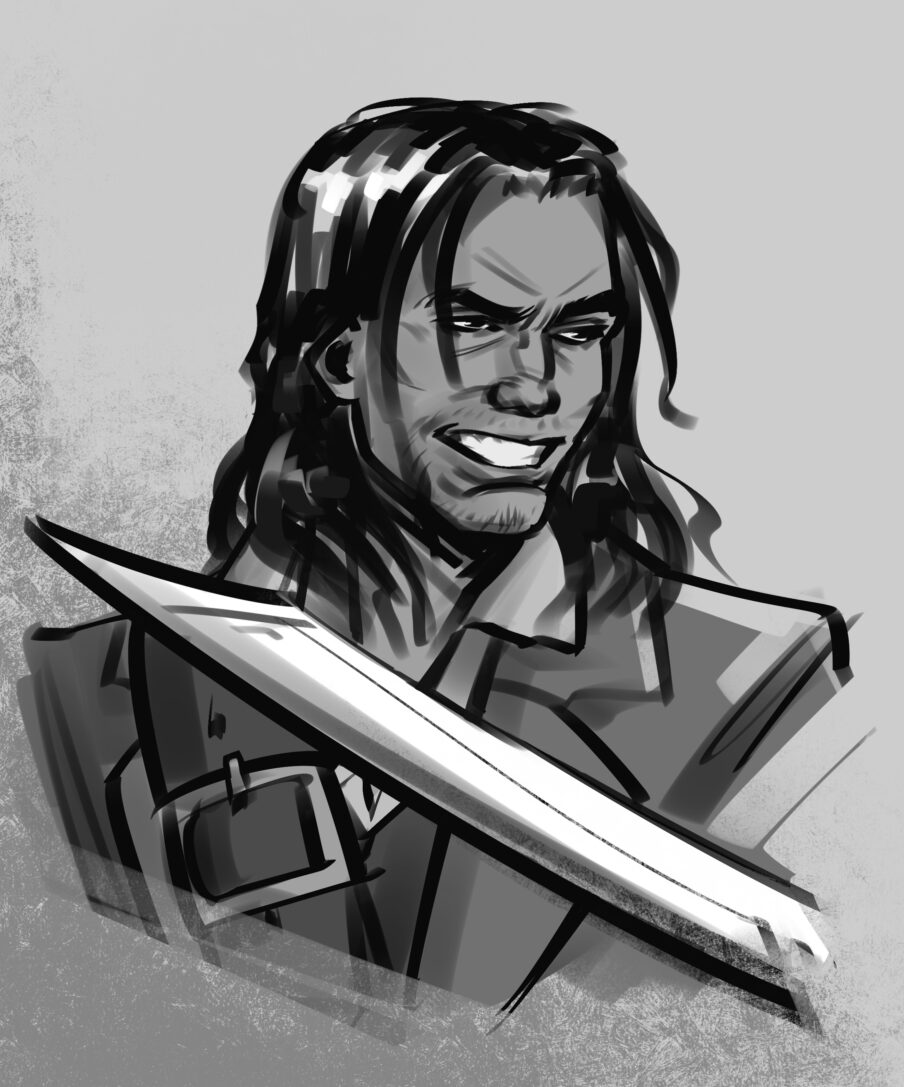
The Search for Howel Davis: Part Three
I promised you a good story, and I’m going to keep my promise. But first, I’d like to share my thoughts on the only witness in the record to offer a glimpse into Howel Davis’s character from first hand accounts.
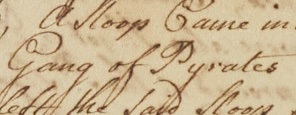
Captain William Snelgrave was a slave-ship captain. In March 1719 his ship, the Bird Galley, was taken in the Sierra Leone river by the pirate Thomas Cocklyn, and he spent roughly the next month in the company of three pirate crews—Cocklyn’s, Olivier Levasseur’s, and Howel Davis’s. He was robbed, threatened, beaten up, and very nearly murdered. He was also, more than once, pulled out of trouble by Davis personally. Davis was the reason he was ultimately freed, and he sailed home in a ship Davis had talked the pirates out of burning. Snelgrave called Davis “a most generous humane Person.”
And I want to be very clear about this: Snelgrave was a man who made his living transporting enslaved people in chains. He defended the slave trade in the same book he wrote about his time as the pirates’ captive, and it’s impossible to take one while ignoring the other. Quite honestly, it made me want to throw out anything Snelgrave said completely, because eff that guy.
Instead, I’ve decided to lay some of it out and let you decide whether Snelgrave’s account of his time with the pirates is worth anything.
His retelling of his month as a prisoner paints the picture of a Howel Davis that is full of contradictions:
- Davis cleverly managed the other pirate captains and their crews, preventing them from committing acts of violence in several instances, then turned around and prepared his men for a battle of revenge over a minor insult.
- He kept his men “in good order,” but then let them engage in “waste and destruction,” dousing themselves and the decks with liquor.
- He recognized a grave danger when a gun flashed near an open scuttle of twenty thousand pounds of gunpowder, mentioned it, then did nothing whatsoever when his ship caught fire. 1
- He was the voice of reason until some pirates who despised him tried to outbid him for a pocket watch, then he dropped a hundred pounds just to win and laugh in their faces.
Snelgrave doesn’t attempt to reconcile any of these contradictions. He doesn’t even seem to notice them. And I’ll be honest, that’s the one thing that makes it all believable.
The fire.
This is the strangest story Snelgrave tells about his time in Howel Davis’s company by far. In the account, Snelgrave doesn’t mention Howel Davis at all after the cannons are fired. What happened in between the cannons and when the fire is put out is a fabrication of my imagination, although, minus Sabrina, may not be far from the truth. For reference, this scene is a flashback that takes place between the beach scene and the dissolution of the partnership in Chapter 30 of The Noble Pirates.
I stood against the bulkhead, in the shadows, surveying the great cabin with a sense of pride. I’d cleaned it up and gotten it ready for dinner myself—swept the floor, shook out the big rug with Sam’s help, and laid it back down under the stern windows.
There were no table and chairs, and that was on purpose, to keep the ship ready for engagement. So I’d set the pewter down directly on the rug and lit new candles all around, in every sconce and along the sills.
Sam hadn’t approved. He still didn’t approve. He stood across from me with his arms folded.
“She’s a fighting ship,” he said, “and you’ve turned her into a parlor.”
“It’s one night,” I said.
He shook his head. “By the time the food comes up there will not be one man in this cabin who does not know your face.”
“Somebody has to serve the wine.”
He looked at the candles for a moment and then back at me. “There is no more wine, nwanyi.”
Meaning, they were drinking liquor.
I stayed quiet. I knew I was playing a dangerous game, but I had to be as close to Howel Davis as I could manage. For both our sakes.
I heard the men laughing and talking amicably as they approached, and my stomach tightened. For what had been far too long, Howel and I had been stealing moments together when we could, which wasn’t nearly often enough. It was the only way to avoid being caught by Cocklyn and Levasseur “La Buse”—the assholes Howel had agreed to partner with. My desperate wish was that he would break from them. Soon.
Before the pirate captains and their company could make it through the door, the musicians shuffled in and lined up against the bulkhead opposite me. There was a new one, I noticed: a young man with a trumpet who looked like he wanted to cry. I bit the inside of my lip.
The forced men always looked this way—particularly the younger ones. And I didn’t blame them one bit.
The voices outside grew louder and I drew a slow breath. Cocklyn was the first one through the door, as I’d anticipated. I detested that nasty little man with all of my being. He burst in, his face in that twisted scowl which also served as a smile. Levasseur strolled in behind Cocklyn with his chin up, surveying the room instead of the people in it. Captain Snelgrave came in next, his face sunburnt and wearing the expression of someone who’d decided he wasn’t going to flinch the next time he was hit.
Howel came in last, which for the longest time I’d thought was good manners but was actually so nobody was ever behind him. He was wearing a second-hand embroidered coat from an earlier prize, navy blue with silver buttons at the cuffs, and it fit him well. His eyes were a vivid blue against his sun-baked skin, and he wore that easy smile on his lips.
He didn’t look at me. He’d gotten very good at not looking at me. Too good, in my opinion.
Snelgrave, however, glanced in my direction, and I noticed that he was wearing the same coat he’d been wearing the day Howel had stood on Cocklyn’s deck and told a crowd of armed pirates that they ought to be ashamed of themselves.
They forget that our reasons for going on the account are to revenge ourselves on base merchants and cruel commanders of ships.
Snelgrave had stood there through it all with a blank face, and when it was over he thanked Howel briefly, and I could tell he had no idea if he’d just been saved or sold. Three weeks later he was having dinner with his pirate captors as a free man.
I had secretly wished they’d sold him. See how that feels. But Snelgrave’s crew had sworn up and down that he was a fair and just captain, so his life had been spared. More than that—Howel had convinced the pirates to give Snelgrave his freedom.
Now, the unwilling guest sat cross-legged as Sam set the enormous bowl of punch in the middle of the rug. Snelgrave had tried to decline the invitation, but Howel had smiled and said he wouldn’t hear of it, and that had been the end of that. The men dipped their tankards into the bowl, filling their pewter to the brims with the blend of French brandy, sugar, citrus, and spice.
Howel ran a dinner party the way he ran a deck. He asked Snelgrave about the weather coming out of Holland, what the Dutch were paying, whether he’d got the lion back on his bow since Kinsale. He listened to the answers like they mattered, then drained his tankard in four swift swallows.
Uh oh. I could tell what kind of evening this was going to be.
They were already refilling their tankards for a third time and it was only eight o’clock. Whenever Cocklyn began to complain about something—usually the men’s lack of respect for him, a favorite topic of his—Howel would say something that was almost funny and Cocklyn would laugh and have more to drink.
The food finally came up and it was a ham. It smelled delicious. The musicians began to play and, despite the tears in his eyes, the young trumpeter was quite good. Cocklyn and Levasseur were relaxed now; they’d had plenty of punch, filled their bellies with a good ham, and were laughing at something I couldn’t hear.
The shout came through the bulkhead and all three pirate captains, who had each imbibed enough alcohol to kill a small horse, were on their feet before I had my back off the wall. The door flew open and a fellow named Robert with bad eczema (which I hadn’t been able to explain to him in a way that was remotely helpful) and his kerchief askew said, “A fire! The main hatchway is all in flame!”2
“Ah,” Levasseur said. The others said nothing as Snelgrave scrambled to his feet and the music stopped abruptly, the trumpet ending on a flat, wet note.
Oh my God.
There were thirteen tons of gunpowder in Howel’s ship, right beneath our feet. It sold better than anything else on these coasts, and Howel’s men had been pulling it out of prizes for six weeks.
I looked at Sam. He looked at me. Then he sighed like a disappointed parent who’d been warning about this sort of thing happening for a while, and no one had listened, so now they were going to pay the price.
Story continues here…
- This is the event I turned into a story below. ↩︎
- Snelgrave writes how a crew member went down into the hold to get some rum from a cask and held his candle to close to the “bung-hole.” And no, I can’t stop laughing and neither can you. He says: “…a Spark fell into the Hogs-head, and set the Rum on fire. This immediately fired another Cask of the same Liquor, whose Bung had been, through carelessness, left open: And both the Heads of the Hogsheads immediately flying out, with a report equal to that of a small Cannon, the fire run about the Hold.” Snelgrave, William. A New Account of Guinea: and the Slave Trade.
Bung-hole. *Snicker* ↩︎
Comments (0)