
The Search for Howel Davis: Part Two
Remember the whole “Pirate Captain David” thing? How, you know, I found a pirate named “David” who stole a random sloop called the Duke and Duchess from Nassau around the exact time Howel Davis was supposed to to have stolen the governor’s sloop, the Buck?
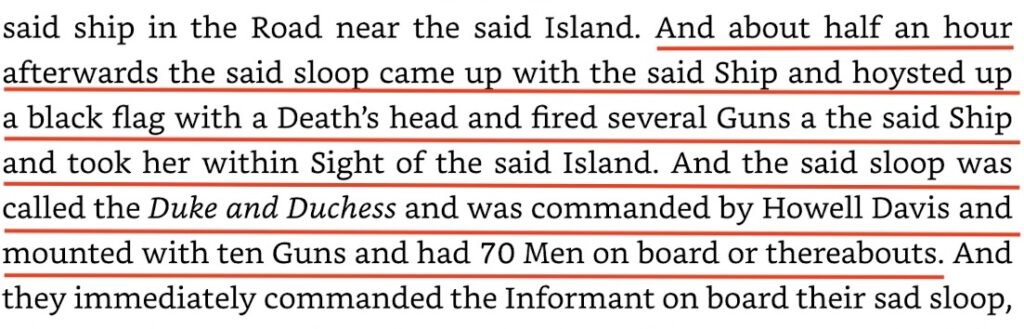
So the Duke and Duchess was actually the Buck. Howel Davis stole the Buck from Woodes Rogers and renamed it the Duke and Duchess—to mock Rogers.
Howel Davis was a smartass
Okay, let me back up. Woodes Rogers was the governor of the Bahamas right when Davis started doing his whole piracy thing. Rogers was famous because, nine years earlier, he’d sailed around the world on this expedition (which was an English privateering mission, to be clear) and rescued a Scottish sailor who was marooned, and the whole incident supposedly inspired Daniel Defoe’s Robinson Crusoe. So for a while there, people were constantly reading about those ships, Rogers, and his heroic escapades.
Here’s the important part: The ships Rogers sailed on were the Duke and Duchess.
Davis and his crew renamed the Buck to the Duke and Duchess to taunt the governor of the Bahamas.1 It was basically a middle finger to the man whose ship he’d stolen.

I’ve spent sixteen years reading and writing about Howel Davis, and I feel like I know him at this point. And that is 100% something he would do. (It’s also not the only time Davis and his crew mocked Rogers in a not-so-subtle way, but that’s for another post.)
I think we can guess why Rogers never wrote Howel Davis’s name down…
Rogers was commissioned governor in January 1718 and sailed from the Thames in April. The previous September, the king had proclaimed a pardon for any pirate who surrendered by September 1718, and put a price on the head of every pirate who didn’t: £20 for a seaman, £100 for a captain, and £200 to any crewman who turned in his own commander. So by spring 1718, every pirate in the Caribbean knew a man was coming with warships and a pardon. More than that, they knew his name, because of the whole “sailing around the world capturing Spanish ships and saving a marooned man” thing.
Of course, Woodes Rogers wasn’t the man who’d hanged anyone—yet. He was just the man coming to end piracy, and Howel Davis was going to become a pirate anyway.
Back to what I was saying. Wait, what was I saying? Oh, right. I FOUND HIM. I saw “Captain David” (because of a drunken fat finger, but we’re ignoring that part) and it made me pause. And now I’ve digested two volumes of E.T. Fox’s Pirates in Their Own Words and I can’t stop smiling.
Based on those accounts, Davis made the Empire flinch, big time. I mean, the documents in Fox’s books are stuffed with Davis from late 1718 through 1719. He knew his time was limited, and he was going to go all out.
Insurrection happened in the said Buck Sloup carried on by one Howell Davies one of the Sailers who all at once seized the Arms of the Ship which lay at the Cabine door, the Captain, Master and Chyrurgeon Drinking in the meantime in the Cabine whom they made prisoners and commanded the vessel having chosen the said Howell Davies for their Captain…2
So primary sources outside Johnson support the assertion that Davis was a smartass pirate who caused a ruckus. What else do they show?
He didn’t like killing people
The interesting part about his path is how he managed to become a big-time pirate without the added murder and mayhem that we all associate with pirates. In fact, he managed to be a pirate while avoiding most of the murder (if not the mayhem). In just a few short months, Davis went from a sailor on a trading sloop to the commander of a thirty-two-gun ship with a hundred and fifty men, and he did it almost entirely through deception rather than force. He pretended to be undermanned and, on a separate occasion, to have a powerful pirate consort behind him. He disguised himself as a Liverpool merchant, an English privateer, a pirate hunter. He dressed his men and coached them on what to say, how to answer certain questions.
Across the surviving accounts of his captures, killing is barely mentioned. And the restraint looks like policy rather than luck, because he did it repeatedly:
“He was taken by one Howell Davis…which they kept the Ship, and set the Captain…Master, and some others, at Liberty…”3
“The Ship Loyal Merchant, Captain Goulden, of London, has been taken by a Pyrate off the Isle of May; the Captain and some of his Crew were set ashore on that Island…”4
“The Captain of one is arriv’d at St. Malo’s on board a Sloop, which the Rogues gave him to bring him home.”5
When Davis captured the Princess, he pressed twelve men to join him—one of them Bartholomew Roberts—and dismissed the rest of them, in the words of a crew member named John Haswell, “without doing them any further harm.”6
Davis’s Articles, as per Johnson, stated that “Quarter should be given whenever it was called for, upon Pain of Death.” In other words: If someone surrendered and asked for mercy, the pirates were required to grant it. A member of the company who killed a man who had surrendered was to be executed by his own crew.
Mind you, all of this is not the same thing as being gentle. He was a pirate captain, after all. In the first quote above, Davis set a bunch of people from the prize “at liberty” then turned around and fired grenado shells at the governor’s house. A chief mate named Edward Green swore that aboard Davis’s sloop he was hoisted to the main top by the neck and had a cord twisted across his ears until he was almost blind—and named Walter Kennedy as one of the perpetrators. Davis himself is described (in a firsthand account, no less) caning a drunk mate off the quarterdeck (the reason for which I will reveal later).
Gentle he was not.
What the record shows is a pirate captain whose method made force unnecessary—not one who didn’t use force.
So now you’re probably thinking, “Okay, this is all great. We know what the man did. But did anyone ever sit down with him and write about what he was like?”
And the answer is yes, one of his captives did. He had dinner with Davis against his will, with a forced trumpeter playing, and kept the ship from exploding as Davis got shitfaced (or did he)…
It’s a good story.

Go to Part 3.
- A shipping report in The Original Weekly Journal states, “He was taken by one Howell Davis, in a Pyrate Sloop of 10 Guns, about 60 Men; the Sloop was formerly call’d the Buck, belonging to the Governor of Providence…” The Original Weekly Journal, 13 June 1719, in Fox, Pirates in Their Own Words, vol. II, doc. 183. ↩︎
- “Confession of Rodger Hughs 18th Aprile 1720,” Argyll Estates Archives, NRAS 1209/197/01. Transcript created by Linda Fryer. ↩︎
- The Original Weekly Journal, 13 June 1719, in Fox, vol. II, doc. 183. ↩︎
- The Original Weekly Journal, 20 June 1719, in Fox, vol. II, doc. 184. ↩︎
- The Weekly Medley, or the Gentleman’s Recreation, 1 August 1719, in Fox, vol. II, doc. 188. ↩︎
- “Confession of John Haswell who formerly called himself John Campbell 16th March 1720,” Argyll Estates Archives, NRAS 1209/197/02. Transcript created by Linda Fryer. ↩︎
Larry November 16, 2026 at 4:07 am
🏴☠️